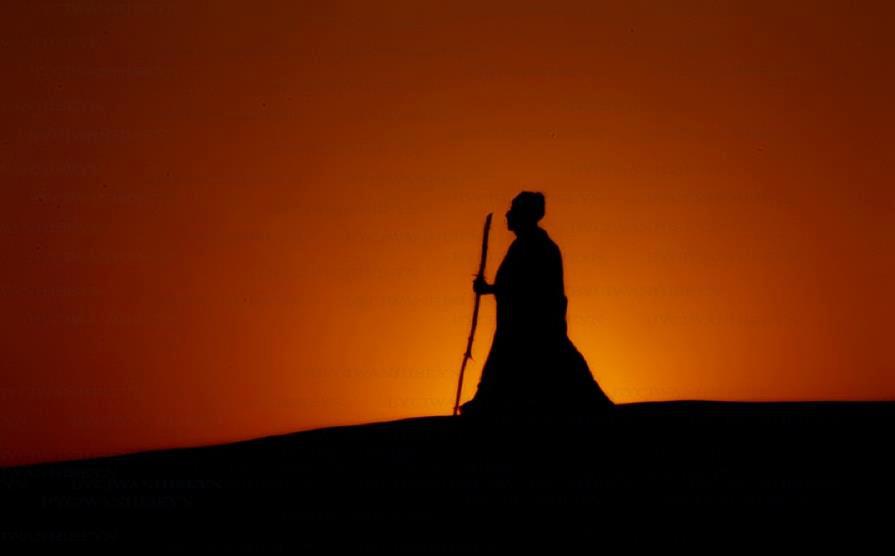
GOD dictates are received in four ways…!!!

GOD stands inseparably by the worshiper’s Self as a charioteer to destroy spiritual ignorance. Worship does not really commence until, through a sage who has known God, the Supreme Spirit himself has not come awake in the worshiper Soul and taken upon himself the task of guidance from one instant to another as also of restraining and disciplining him, and escorting him safely across the incongruities of nature.

At this stage God begins to command from all sides. But at the beginning, it is through an accomplished sage that he speaks. If a seeker is not fortunate enough
to have
such a sage as a teacher, God’s voice is only faintly audible to him.

Sri Krishn has preached in Bhagavad Gita:

tesāmevānukampārthamahamajñānajam tamah
nāśayāmyātmabhāvastho jñānadīpena bhāsvatā

‘To extend my grace to them, I dwell in their innermost being and dispel the gloom of ignorance by the radiance of knowledge.”
*
*
The charioteer, whether he is the worshiped deity or a teacher- preceptor, or God himself, is the same. When the charioteer has awakened in the worshiper’s Self,
his dictates are received in four ways.

At first there is the experience that is related to gross breath: of the infusion into it of a thought that was earlier not in it. When a worshipper sits in meditation, he is confronted with a number of questions.

When is his mind going to be truly absorbed?
To what extent is it already absorbed?
When does his mind desire to escape from nature
and
when has it strayed from the path?

The answers to these questions are signalled every moment by the adored God through physical reflexes.Twitching of limbs is an experience related to gross breath and it appears simultaneously at more than one point even within a moment.
If the mind has deviated,
these signals are transmitted minute after minute.

But these signals are received only if the devotee holds on to the form of the worshiped Godlike teacher with undeviating firmness. Reflex actions such as twitching of limbs are a much too frequent experience of ordinary beings because of the clash between their contradictory impulses, but these have nothing to do whatsoever with the signs that are transmitted to worshipers who are wholly dedicated
to
the sublime object of their worship.

The other experience is connected with the awakening of breath in dreams. Ordinary men dream according to their desires, but when a worshiper cleaves to God even dreams are transformed into divine instructions.
Rather than dreaming, yogi perceive the act of becoming.

 These two experiences are both preliminary. Association with a sage who has known reality, having faith in him, and rendering him even a token service suffice to bring about these experiences.
But the two subsequent experiences of a worshiper are more subtle and dynamic,
and
they can be had only through active practice-only by really walking along the path.

The third experience is that of awakening into profound sleep. All of us in the world after all, as it were, lie immersed in slumber. We are but lying in a state of insensibility in the dark night of ignorance. And whatever we do, day and night, is but a dream.

Profound sleep here refers to the condition that follows after the stage when the memory of God flows through the worshiper so very like a perennial stream that his vision of God is permanently fixed in the mind. This is that serene and blessed mood in which the worshiper is led gently on by his affections, and in which, while the physical breath is suspended and he is laid asleep in body,
he becomes“a Living Soul.”

This is the state of harmony and of deep joy in which the worshiper is blessed
with
an insight into the very life of things.

In such a condition the worshiped God transmits yet another signal, which manifests itself in the form of an image that is in consonance with the yogi’s prevailing mood and provides the correct direction, thus acquainting him with the past and the present.

My revered teacher would quite often tell us that even like the Surgeon who first renders a patient unconscious and then cures him by the application of a suitable remedy, God-when the flame of worship is strong and steady-imbues the devotee with awareness of the state of his faith and worship to cure his spiritual sickness.

The fourth and final experience is of the spiritual awakening that leads to evenness of breath. This is the state in which the worshiper is on par with that God whose thought he has fixed his mind on as on a tangible object.
This realization arises from within the Self and once this awakening has taken place, at every moment while sitting idly or up and active, the worshiper pre-visions occurrences that shall be
and
thus gains omniscience.

This is the state, too, in which there arises a sense of oneness
with
the embodied Self.

This final experience is generated when the darkness of ignorance
is
dissipated by the light of knowledge through the agency of a timeless
and
unmanifest sage who has awakened in his Soul.

[Revered Adgadanandji Gurudev]

*

Metaphysical guidance of most revered Gurudev 
for seekers
while traversing upon
the
“Path of Self Realization”

Humble Wishes!!! 

Leave a comment

The One & Only God’s Name is Recited at Four Levels: Baikhari, Madhyama, Pashyanti, and Para!

Bhagavad Gita sings:

“As some offer their exhalation to inhalation, others offer their inhaled breath to the exhaled breath, while yet others practise serenity of breath by regulating their incoming and outgoing breath.”

Meditators on the Self sacrifice prān (vital air) to apān, and similarly apān to prān. Going even further, other yogis restrain all the life-winds and take refuge in the regulation of breath (prānāyām). What Shri Krishna calls prān–apān, Mahatma Buddha has named ānāpān. This is also what he described as śwās–prashwās (inhaling and exhaling).

Pran is the breath that is inhaled, whereas apan is the breath that moves out. Sages have discovered through experience that, along with the breath, we also absorb desires from the surrounding environment and, likewise, transmit waves of our inner thoughts—both pure and impure—with our exhalations.

The non-assimilation of any desire from an external source is the offering of prān as oblation, whereas the suppression of all inner desires is the sacrifice of apān—so that neither internal desires arise nor grief generated by thoughts of the external world. When both prān and apān are properly balanced, the breath becomes regulated. This is prānāyām, the serenity of breath. It is the state in which the mind becomes supreme, for the restraint of breath is inseparable from the restraint of the mind.

Every accomplished sage has taken up this subject, and it is mentioned in the Vedas. (Rig, 1.164.45 and Atharv, 9.10.27).

This is what revered Gurudev also says. According to him, the one and only name of God is recited at four levels: Baikhari, Madhyama, Pashyanti, and Para.

Baikhari is the level at which the name is manifest and audible. It is pronounced in such a way that both we ourselves and those around us can hear it.

Madhyama is the recitation of the name in a soft, murmured tone—audible only to the worshiper, but not even to the person sitting beside him. This articulation arises within the throat, gradually generating an unbroken stream of inner harmony.

When worship becomes even more refined, the seeker reaches a stage where he develops the capacity to visualize the name. At this point, the name is no longer recited, for it has become an integral part of the life-breath itself. The mind stands as a mere onlooker, simply observing what the breath expresses.

When does it come in? And when does it go out? And what does it express?

Sages of realization tell us that the breath articulates nothing except the Name. At this stage, the worshiper no longer recites the Name; he simply listens to the subtle melody of the Name arising from his breath. He merely observes his breath, and this is why this stage of breath-awareness is called Pashyanti.

At the stage of Pashyanti, the mind is positioned as a witness—an onlooker. But even this witnessing is no longer required when the discipline becomes still more refined.

When the chosen Name is firmly imprinted upon memory, its melody is heard spontaneously. There is no longer any need for recitation, for the Name resounds in the mind by itself. The worshiper does not recite it anymore, nor does he compel the mind to listen, and yet the recitation continues on its own. This is the stage of Ajapa—the un-recited.

It would, however, be a mistake to assume that this stage can be reached without first beginning the process of recitation. If recitation has never been initiated, Ajapa cannot arise. Ajapa is that form of recitation which does not leave us even when we ourselves do not recite it. When the memory of the Name is firmly established in the mind, the recitation begins to flow through it like a perennial stream.

This spontaneous recitation is called Ajapa, and it is the recitation that arises through transcendental articulation (Paravāaṇī). It leads the seeker to God, who is the essence beyond nature. After this stage, there is no further variation in speech, for once the vision of God is granted, speech is dissolved in Him. This is why it is called Para.”

In the verse quoted above, Shri Krishna instructs Arjun only to observe his breath; however, later He Himself emphasizes the importance of intoning OM.

Gautam Buddha too has elaborated on inhalation and exhalation in Ānāpān Sati. After all, what does the Yogeshwar truly intend to convey?

In truth, beginning with Baikhari, then progressing to Madhyama, and going even further to the stage of Pashyanti, one gradually attains mastery over the breath. At this level, recitation becomes integrated with the breath itself. And what remains to be recited when the worshiper now only has to observe his breath?

“This is why Shri Krishna speaks only of pran–apan rather than instructing Arjun to ‘recite the Name.’ There is no need to tell him this. If He were to say it explicitly, the worshiper might go astray and begin to wander in the dark alleys of the lower stages.

Mahatma Buddha, my noble and God-like teacher, and all those who have walked this path affirm the same truth. Baikhari and Madhyama are the portals through which we enter the realm of recitation. Pashyanti is the stage that grants access to the inner Name. In Para, the Name begins to flow in an unbroken, continuous stream, and from this point onward, the internal and spontaneous intoning of the Name never forsakes the worshiper.

The mind is linked with the breath. Victory over the mind is achieved when the gaze is fixed upon the breath, when the Name is woven into the breath, and when no desire from the external world can enter the worshiper. This is the state in which the final fruit of yagya manifests.

Sri Krishna adds further :

“Yet others who subsist on strictly regulated breath and offer their breath to breath, and life to life, are all knowers of yagya, and the sins of all who have known yagya are destroyed.”

Those who partake of regulated food offer their breath to breath—life to life—as an oblation. My noble teacher, the revered Gurudev, used to say that a yogi’s food, posture, and sleep should be steady and balanced. Regulation of food and sensory pleasure is essential.

Many yogis who observe such discipline merge breath into breath, focusing on the inhalation and paying no attention to the exhalation. With each incoming breath, they hear the sound of OM. Thus, those whose sins have been destroyed through yagya are the true men of knowledge.

Sri Krishna says:

“O the best of Kuru, the yogi who have tasted the nectar flowing from yagya attain to the eternal supreme God, but how can the next life of mankind bereft of yagya be happy when even their life in this world is miserable?”

What does yagya generate—what is the fruit that arises from it? It is nectar, the very substance of immortality. The direct experience of this nectar is wisdom itself. Whoever partakes of it becomes one with the eternal God.

Thus, yagya is that sacred process which, upon its completion, unites the worshiper with God. According to Shri Krishna, how can the next world bring happiness to those who are bereft of yagya, when even a mortal human birth remains beyond their reach?

It is their inevitable lot to be born in lower forms, with nothing better available to them. Thus, the observance of yagya is a necessity.

By practicing yagya under the guidance of an enlightened sage, the mind and senses become completely restrained. As I personally feel, there is no other option and no alternative path.

[Revered Adgadanandji Gurudev]

Key guidance by most revered Gurudev
to be learnt by heart
while traversing upon
the
“Path of Self Realization”

Humble Wishes!!!

2 Comments

“He who departs from the body intoning OM……..!!!

Sri Krishn sings in Bhagavad Gita:

omityekāksaram brahma vyāharanmāmanusmaran
yah prayāti tyajandeham sa yāti paramām gatim

“He who departs from the body intoning OM, which is God in word, and remembering me, attains to salvation.”

The sage who dies with the knowledge that the imperishable God is the one reality achieves the state of sublime bliss.

Sri Krishn is a yogi, a seer who has achieved awareness of the ultimate truth. As a realized sage, an accomplished teacher, he exhorts Arjun to recite OM, symbol of God, and contemplate him.

All great Souls are known by the name of the entity to which they attain and into which they are finally assimilated. It is for this reason that Sri Krishn prompts Arjun to utter the name of God but remember his own ( Sri Krishn’s ) form.

Let us note that he does not tell Arjun to recite his name. With the passage of time, though, Sri Krishn was deified and men began to recite his name; and they are rewarded but only according to the nature of their dedication. Sri Krishn has told Arjun that it is he who both strengthens the devotion of such worshipers and determines their rewards. But these rewards are destroyed along with their recipients.

It is useful to remember how Lord Shiv, the initiator of yog, insisted on the recitation of the syllable “Ram” that signifies the omnipresent God who can be experienced only as an inner voice. Sant Kabir is also said to have committed himself to the constant recitation of the two sounds represented by
“ra” and “m.” And Sri Krishn here advocates the usefulness of OM.

God is known by innumerable names, but only that name which prompts and confirms faith in the one God is
worthy of constant remembrance and recitation. Worshipers are rightly cautioned by Sri Krishn that the name they recite time and again must not be one that might incline or encourage them to believe in a multiplicity of gods and goddesses who are nothing more than a bundle of myth.

OM is unique in the sense that it literally betokens that the supreme authority of God inheres in every “me.”

So seekers must desist from wandering here and there to find him outside themselves.

The most revered Swami Paramanad Paramhans Gurudev Ji would often advise his devotees to keep in mind his form while intoning some name like OM, Ram or Shiv: to visualize him and, with him before the mind’s eye, to remember the identical god-the object of their worship.

It is an accomplished teacher who is kept in view while meditating.

Whether we hold on to a Ram, Krishn, or a hermit who is liberated from all desire and pleasure of the senses, or to any other being according to our inclination, we can know them only by actual experience, after which they disclose to us the way to some contemporary and accomplished teacher whose guidance we should slowly but
surely follow to conquer the material world.

Novices utter the deity’s name, but hesitate to do so while calling a sage in human form. They are unable to discard the bias of their inherited beliefs. So they call to mind some other false god instead. But this practice is, as we have seen, forbidden by Yogeshwar Krishn as impious.

The proper way is to find refuge in some realized sage, an accomplished or enlightened teacher,
who has already gone through the experience.
Fallacious dogmas are then destroyed and the worshiper is enabled to set upon real action as his pious impulses and the capacity to act according to them are rendered sufficiently strong. So, according to Sri Krishn, the mind is restrained and ultimately dissolved by a simultaneous recitation of OM and remembrance of his form.

This is the point at which the accumulated layers of sanskar-of the merits of action- are dissolved
and all the relationships of the body severed forever.

A man is not rid of the body by just physical death.

~ Revered Adgadanandji Gurudev ~

A key suggested by most revered Gurudev
to keep in mind 
while traversing upon
the 
“Path of Self Realization”

Humble Wishes
Gratitude: YouTube.

Leave a comment

Control of the mind..!!!

What is control of the mind?
Control really means being indifferent to the vagaries of the mind.
It is difficult to control the mind,
just as it is difficult to confine air in one’s grasp.
How can anyone control the mind which is all-pervading in the vastness of its range and
comprehension?

When it is realized that the mind is made up of thoughts and doubts, the elimination of the thoughts is the means of restraining the mind.
Thoughts are associated with desires.

As long as desires remain, one cannot have detachment.

It is necessary to limit desires.
When there is no restraint, excessive desire becomes an evil. It leads to misery. When we strive to control desire, in due course, it develops into
non-attachment or renunciation.

Control of the mind
is must
while traversing upon
the
“Path of Self Realization” 

Humble Wishes!!! 

Leave a comment

So wherever Vishwamitr-an enlightened sage-is, the Ved abide there!!!

The great sage Vishwamitr, we are told, was absorbed in meditative penance. Pleased with this, Brahma appeared and-said to him,
“From this day you are a sage (rishi).”

But not satisfied with this, the hermit went on with his intent contemplation. After a while Brahma, now accompanied by other gods, returned and said,
“From today you are a royal sage (rajarshi).”

But since Vishwamitr’s wish was yet unfulfilled, he continued with his incessant penance.Attended upon by gods, virtuous impulses that constitute thetreasure of divinity, Brahma came back again and told Vishwamitrthat from that day he was
a
supreme sage (maharshi).

Vishwamitr then said to the oldest of all gods,“No, I wish to be called a brahmarshi (Brahmin sage) who has conquered his senses.” Brahma protested that it could not be because he had not yet subdued his senses. So Vishwamitr resumed his penance, so rigorously this time that the smoke of the fire of penance began to rise from his head. Gods then entreated Brahma and the Lord of creation once more appeared before Vishwamitr and said,
“Now you are a brahmarshi.”

There upon Vishwamitr rejoined, “If I am a brahmarshi, let the Ved wed me.” His prayer was granted and the Ved was awakened in his heart. The unknown essence-all the mysterious knowledge and wisdom of the Ved-now became known.

This direct apprehension of truth rather than a book is Ved.
So wherever Vishwamitr –
an enlightened sage-
is,
the Ved abide there.


True wisdom always abides
wherever
an enlightened sage
is
and this knowledge leads to
the
“Path of Self Realization.”

Humble Wishes!!!

Leave a comment

Om purnamadah purnamidam purnat purnamudacyate…!!!!

Om purnamadah purnamidam
purnat purnamudacyate
purnasya purnamadaya
purnamev avasisyate

This is the whole;
The whole becomes manifest;
Taking away the whole
From the whole,
The whole remains.

Sing Upanishads…!!!

“From the whole
the whole remains”
which
gets revealed while traversing upon
the
“Path of Self Realization.”

Humble Wishes!!!
Gratitude:YouTube. 


Leave a comment